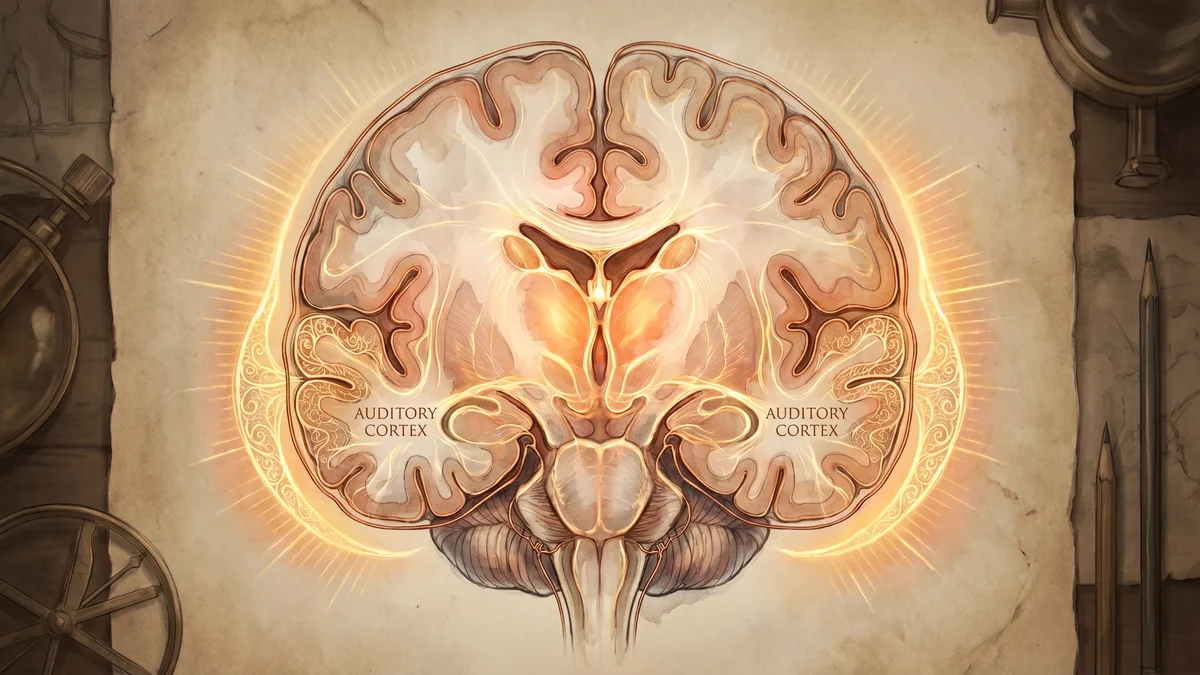

The Silent Edit
Imagine a sculptor who, over many years, has carved a masterpiece. Now, imagine that same sculptor beginning to remove clay from a finished work, creating a void where there was once form. This is the essence of what happens in the auditory cortex when tinnitus begins. It is not an addition, but a subtraction. The brain, the master sculptor of our sensory world, notices the absence of an expected signal from the ears and, in its attempt to perceive what is missing, it creates a phantom. Stay with me here. The ringing, the hissing, the buzzing... it is the sound of the brain noticing a silence, a silence carved out by the slow, inexorable loss of auditory input. This is the beginning of a significant process of neural remapping, proof of the brain's relentless, and sometimes tragic, plasticity.
The auditory cortex is not a static receiver of information. It is a dynamic, living map, a territory that is constantly being updated based on our experience. As the research of neurophysiologists like Aage Moller has shown, this map is exquisitely organized by frequency, a tonotopic map. When input from the ear at a specific frequency is lost, the neurons in that corresponding area of the map become untethered. They are like workers who have been laid off but still show up to the factory every day, looking for something to do. In their idleness, they become hyperexcitable, firing spontaneously and creating a signal where none exists. This is the birth of the phantom sound.
But the brain's plasticity does not stop there. This newly active, but now un-anchored, region of the auditory cortex begins to be encroached upon by its neighbors. The neurons representing adjacent frequencies, which are still receiving input, start to invade the silent territory, a process known as cortical remapping. This is a hostile takeover at a microscopic level, a neural land grab. This process can further entrench and complicate the tinnitus signal, making it more strong and harder to ignore. The brain, in its attempt to adapt to a loss, has inadvertently created a new and persistent problem.
The Architecture of Sound and Suffering
The formation of the tinnitus signal through cortical plasticity is a fascinating, if unfortunate, piece of neuroscience. But it does not, on its own, explain the immense suffering that so often accompanies the sound. For that, we must look at the brain's larger architecture, at the complex web of connections between the auditory cortex and other, more powerful brain regions. The work of researchers like David Baguley has been instrumental in illuminating this broader network perspective on tinnitus. The sound is not the problem. The problem is what the rest of the brain *does* with the sound.
As the new, persistent signal from the auditory cortex propagates through the brain, it is intercepted by the limbic system, the seat of our emotional life. The amygdala, the brain's threat detector, often flags this novel, persistent signal as a potential danger. This is a crucial, and catastrophic, misinterpretation. The sound becomes linked with a state of fear and anxiety, creating a powerful, conditioned response. The sound is no longer just a sound; it is a harbinger of distress, a constant reminder of a perceived threat. Here is where the suffering is born, in this unholy alliance between the auditory and limbic systems.
This part surprised me too. It is not the sound itself, but our reaction to it, that drives the negative experience. The prefrontal cortex, the part of our brain responsible for attention and executive control, is then recruited into this drama. Because the signal has been tagged as a threat, the prefrontal cortex prioritizes it, locking our attention onto the sound. This creates a vicious cycle: the more we attend to the sound, the more threatening it seems, and the more threatening it seems, the more we attend to it. We become trapped in a feedback loop of our own making, a prisoner of our own brain's protective, but misguided, mechanisms.
Something worth considering might be the Bose Sleepbuds II. Many readers have found the Chamomile Tea by Traditional Medicinals (paid link) helpful for this.
The self you're trying to improve is the same self doing the improving. Notice the circularity.
The Un-Learning Process
If the suffering of tinnitus is a learned response, a product of neural plasticity, then it stands to reason that it can be un-learned. This is the hopeful message at the heart of modern tinnitus management. We can use the very same plasticity that created the problem to create the solution. This is not about finding a way to eliminate the phantom sound, but about retraining the brain to change its interpretation of, and reaction to, the sound. It is a process of neural re-education, of teaching the brain that the sound is, in fact, a neutral event, not a threat.
This un-learning process is the basis for therapies like Tinnitus Retraining Therapy (TRT), which combines counseling with sound therapy. The goal is to habituate to the sound, to reach a point where it is no longer consciously perceived or, if it is perceived, it no longer elicits an emotional response. The counseling component helps to clarify the tinnitus, to remove the fear and catastrophic thinking associated with it. The sound therapy component uses low-level, broadband noise to decrease the contrast between the tinnitus signal and the background auditory environment, making the tinnitus less detectable and giving the brain a new, neutral sound to focus on.
In my years of working in this territory, I have seen how this process can transform a person's life. It is a slow, gradual journey of building new habits of perception and reaction. It is about learning to live with the sound, not as an enemy to be fought, but as a neutral companion. It is about using our conscious awareness to guide the plastic processes of the brain in a more helpful direction. We are not passive victims of our neurology; we are active participants in its ongoing creation.
Most of what passes for healing is just rearranging the furniture in a burning house.
Attention as a Creative Act
The faculty of attention is one of the most powerful tools we have for shaping our experience of reality. Where we place our attention, our energy flows. In the context of tinnitus, the attentional system has often been hijacked, locked onto the phantom sound as if it were the only thing worth listening to. The practice of reclaiming our attention is therefore a central part of the healing journey. It is a creative act, an act of choosing what we will increase and what we will allow to recede into the background.
This is not about the brute force of "ignoring" the sound, which is a form of resistance that often backfires. It is about the gentle, persistent, and intentional placement of our attention on other things. It is about deeply engaging with the sensory world that is always available to us: the feeling of the breath, the taste of food, the sight of a sunset, the sound of music. When we fill the canvas of our awareness with these other, richer experiences, the tinnitus signal naturally becomes less prominent. It is still there, perhaps, but it is no longer the star of the show.
Another option worth considering is the Jarrow Formulas B-Right Complex (paid link). A popular choice for situations like this is Tinnitus Activities Treatment.
This is a practice, not a one-time fix. It requires a daily commitment to choosing where we will place the spotlight of our awareness. It is a form of mental strength training, a way of building the muscle of attentional control. As we get better at this, we find that we have more and more choice in what we experience. We are no longer at the mercy of the automatic, threat-driven attentional habits of the brain. We are becoming the conscious creators of our own inner world.
Every moment of genuine attention is a small act of liberation.
The Dissolution of the Listener
At the deepest level, the journey with tinnitus can become a significant spiritual inquiry. It forces us to ask the question: who is it that is hearing this sound? Who is it that is suffering? The contemplative traditions have long pointed to a radical answer: the listener, the self that we believe to be at the center of our experience, is an illusion. It is a construct of thought, a story we tell ourselves. When we investigate our experience directly, we find that there is no central, solid self to be found. There is only the hearing, the thinking, the feeling, arising and passing away in a vast, open field of awareness.
This is not an easy concept to grasp, but it can be directly experienced through mindfulness and other contemplative practices. As we learn to rest in this open awareness, we begin to dis-identify from the contents of our experience. The tinnitus is still there, but it is no longer happening to *me*. It is simply a phenomenon that is arising in awareness. The personal, emotional charge begins to fall away. The suffering, which is rooted in the identification with a self who is having an experience it does not want, begins to dissolve.
This is the ultimate freedom. It is not the freedom from the sound, but the freedom from the self who is bothered by the sound. It is the realization that what we are is not the small, contracted, suffering self, but the vast, open, and silent awareness in which all experiences, including the phantom sound, arise and pass away. The sound becomes a pointer, a guide, a teacher, leading us to a truth about ourselves that is deeper and more significant than we ever imagined.
The contemplative traditions all point to the same thing: what you're looking for is what's looking.
The Tender Path of Plasticity
The brain's capacity for change, its plasticity, is the source of both our entrapment and our liberation. The very same mechanism that allowed the brain to learn the habit of suffering can be used to teach it the habit of peace. This is a tender path, one that requires patience, compassion, and a deep trust in the brain's innate capacity for healing and growth. It is not a path of fighting or forcing, but of allowing and guiding. It is a dance with our own neurology, a co-creative process of shaping our own inner world.
The phantom sound may have been born from a silent edit, a void in our sensory map. But it does not have to be the final word. We can learn to fill that silence not with a phantom, but with a new kind of presence, a new kind of awareness, a new kind of peace. We can use this experience as an opportunity to become more intimate with the workings of our own minds and hearts, to become more skilled in the art of living. The sculptor's work is never truly finished. There is always more clay to be added, more form to be discovered, more beauty to be revealed.
Your Healing Journey: Tools Worth Exploring
While there is no single solution for tinnitus, many people find that the right combination of tools and practices makes a real difference in daily life. Here are some options that align with what we have discussed in this article.
Something worth considering might be the Bose Sleepbuds II. Check out the NOW Supplements NAC 600mg (paid link) and see if it fits your situation.
A popular choice for situations like this is Tinnitus Activities Treatment. Check out the Mini Stepper by Sunny Health (paid link) and see if it fits your situation.
For those looking for a simple solution, Living Well with Tinnitus is worth reading. Check out the CoQ10 by Doctor's Best (paid link) and see if it fits your situation.
Something worth considering might be the Loop Experience Ear Plugs. Check out the Nordic Naturals Ultimate Omega (paid link) and see if it fits your situation.
We may earn a small commission from Amazon purchases, which helps support this site at no extra cost to you.
Frequently Asked Questions
Why did my tinnitus start for no reason?
While it can often feel like tinnitus appears out of the blue, there is almost always an underlying cause, even if it's not immediately obvious. The most common cause is some degree of hearing loss, which can be very subtle and not noticeable in your daily life. This loss can be due to cumulative noise exposure over many years, age-related changes (presbycusis), or even a single event of loud noise exposure. Other triggers can include certain medications, jaw or neck issues (somatic tinnitus), or periods of high stress, which can lower your threshold for perceiving an already-existing, but previously unnoticed, phantom sound. It's a complex phenomenon, and often it's a combination of factors rather than a single cause.
Is there a connection between tinnitus and hyperacusis?
Yes, there is a very strong connection. Hyperacusis is a condition where everyday sounds are perceived as abnormally loud, intrusive, and even painful. Both tinnitus and hyperacusis are thought to be related to a