
The Armor We Wear
I've sat with people who carry the weight of the world in their shoulders, their necks so tight that they seem to be in a perpetual state of bracing for impact. Their jaws are clenched, their brows are furrowed, and their breath is a shallow, almost imperceptible movement in the upper chest. And somewhere, in the midst of this landscape of tension, there is a sound, a high-pitched ringing, a low-frequency hum, a constant companion that they have come to know as tinnitus. This is the reality for so many who live with this condition: the sound is not just a sound; it is a physical experience, a felt sense of contraction and armoring that permeates their entire being. Stick with this for a moment.
We are taught to think of the mind and body as separate entities, to believe that our thoughts and emotions are somehow distinct from our physical sensations. But the body keeps the score. Every stress, every trauma, every unresolved emotion is stored in the tissues of the body, in the chronic tension of the muscles, in the restricted patterns of the fascia. And for many people with tinnitus, this tension is most pronounced in the muscles of the neck, jaw, and shoulders, the very muscles that are so intimately connected to the auditory system. Massage therapy, in this context, is not just a luxury; it is a necessity, a way of beginning to dismantle the armor that has been built up over a lifetime.
The Language of Touch
A skilled massage therapist is a master of the language of touch. They are able to listen with their hands, to feel the subtle nuances of tension and restriction in the tissues, and to respond with a quality of touch that is both precise and compassionate. This is not about simply rubbing the muscles until they relax. It is a deep and interactive process, a dialogue between the therapist and the client's body. The therapist may use a variety of techniques, from the long, flowing strokes of Swedish massage to the deep, sustained pressure of neuromuscular therapy, to release the trigger points and adhesions that are contributing to the tension.
But the real magic of massage therapy lies not in the techniques themselves, but in the quality of presence and attention that the therapist brings to the session. It is in the creation of a safe and supportive space where the body can finally begin to let go, to release the patterns of holding that have become so deeply ingrained. For many people, this is the first time that they have ever allowed themselves to be touched with such care and attention, the first time that they have ever felt truly seen and met in their physical experience. I know, I know. It sounds simple, but in our touch-deprived culture, it is a radical act.
“When you stop trying to fix the moment, something remarkable happens - the moment becomes workable.”
The Brain's Perception of Sound
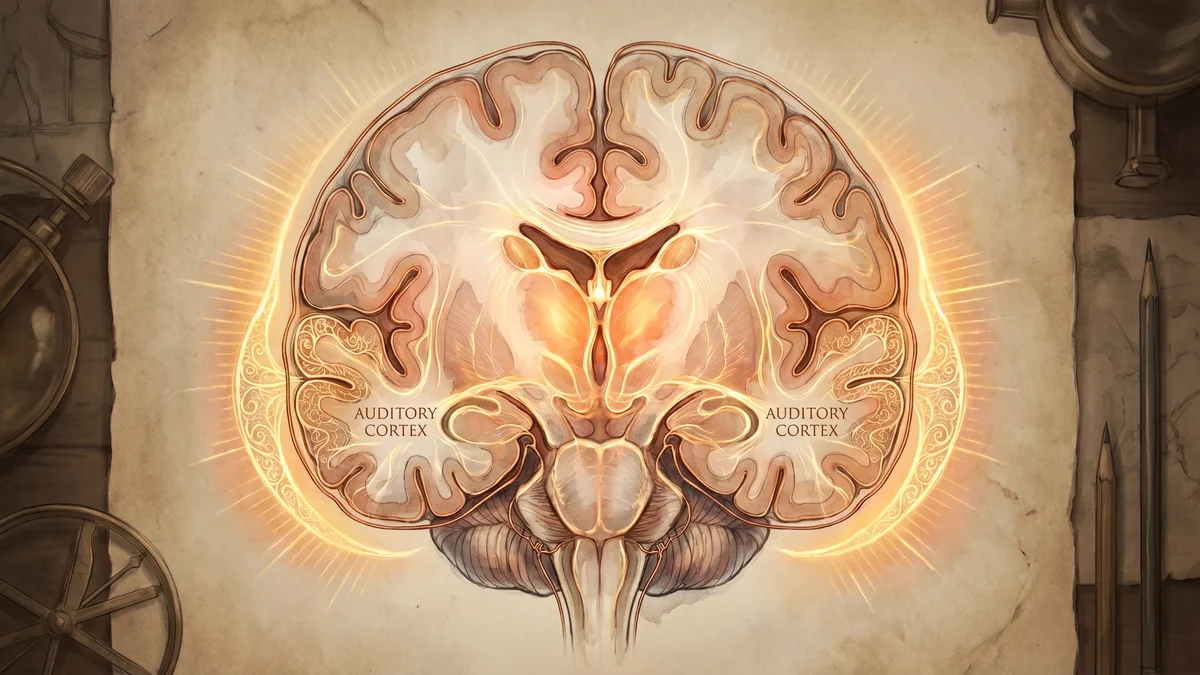
The research of Georgetown neuroscientist Josef Rauschecker has shed light on the complex role that the brain plays in the experience of tinnitus. Rauschecker's work suggests that tinnitus is not just a problem in the ear, but a problem in the brain's ability to filter out unwanted auditory signals. The brain, in a sense, becomes hyper-vigilant, constantly scanning for threats, and the sound of tinnitus becomes one of those perceived threats. Here is where the connection to muscle tension becomes so clear. When the body is in a state of chronic tension, it is sending a constant stream of alarm signals to the brain, telling it that there is a threat, that it needs to be on guard.
Something worth considering might be the Comfy Brace Posture Corrector. Many readers have found the Chamomile Tea by Traditional Medicinals (paid link) helpful for this.
Massage therapy, by helping to release this chronic muscle tension, can have a direct effect on the brain's perception of sound. As the body begins to relax, as the nervous system shifts from a state of sympathetic arousal to one of parasympathetic ease, the brain begins to receive a different set of signals. It begins to learn that it is safe, that it can let down its guard, that it no longer needs to be on high alert. And as the brain's state of vigilance begins to decrease, the perceived loudness and intrusiveness of the tinnitus can begin to diminish.
“Every resistance is information. The question is whether you're willing to read it.”
The Jaw-Tinnitus Connection
One of the most common, and often overlooked, sources of tinnitus-related muscle tension is the temporomandibular joint, or TMJ. This is the joint that connects your jaw to your skull, and it is surrounded by a complex network of muscles that are responsible for chewing, talking, and yawning. When these muscles become tight and overworked, either through stress, teeth grinding, or a misaligned bite, they can refer pain and tension to other parts of the head and neck, including the ear. In fact, many people with TMJ dysfunction also experience tinnitus, a condition known as somatosensory tinnitus.
Massage therapy can be incredibly effective in releasing the tension in the muscles of the jaw, both from the outside and, with proper training and consent, from the inside of the mouth. This can be a strange and intense experience for some, but it can also be significantly relieving, as it can begin to address the root cause of the tension that has been driving the tinnitus. It is a powerful reminder that the body is a deeply interconnected system, and that a problem in one area can often have surprising and far-reaching effects.
“The question is never whether the pain will come. The question is whether you'll meet it with presence or with narrative.”
The Uncomfortable Question
So, what if the path to quiet is not through the ears, but through the body? What if the relentless pursuit of a cure, the constant searching for a way to silence the sound, is actually contributing to the tension that is perpetuating it? These are not easy questions to ask, and they may not have simple answers. But they are the questions that we must be willing to ask if we are to move beyond the limitations of our current understanding and to open ourselves to new possibilities for healing.
Another option worth considering is the Jarrow Formulas B-Right Complex (paid link). One option that many people like is a Therapy Putty Set.
The journey with tinnitus is a journey into the heart of the unknown, a journey that asks us to let go of our need for certainty and to embrace the messy and unpredictable nature of our own experience. It is a journey that asks us to become intimate with our own bodies, to listen to their whispers, and to respond with courage and with grace. And in the end, it is a journey that may lead us not to a place of silence, but to a place of significant and unshakable peace. What are you willing to let go of in order to find it?
“The research is clear on this, and it contradicts almost everything popular culture teaches.”
Your Healing Journey: Tools Worth Exploring
While there is no single solution for tinnitus, many people find that the right combination of tools and practices makes a real difference in daily life. Here are some options that align with what we have discussed in this article.
Something worth considering might be the Comfy Brace Posture Corrector. Check out the NOW Supplements NAC 600mg (paid link) and see if it fits your situation.
One option that many people like is a Therapy Putty Set. Check out the Mini Stepper by Sunny Health (paid link) and see if it fits your situation.
A tool that often helps with this is a Lacrosse Massage Ball Set. Check out the CoQ10 by Doctor's Best (paid link) and see if it fits your situation.
We may earn a small commission from Amazon purchases, which helps support this site at no extra cost to you.
Frequently Asked Questions
Can massage make my tinnitus worse?
It is very unlikely that massage therapy will make your tinnitus worse. In some cases, you may experience a temporary increase in the sound as the body begins to release long-held tension, but this should subside within a day or two. It is important to communicate with your therapist about your experience so that they can adjust their pressure and technique to meet your needs.
What kind of massage is best for tinnitus?
There is no one 'best' type of massage for tinnitus, as the most effective approach will depend on the individual and the underlying cause of their muscle tension. However, modalities that focus on releasing chronic tension and trigger points, such as neuromuscular therapy, myofascial release, and trigger point therapy, can be particularly helpful. It is most important to find a therapist who is skilled, experienced, and who you feel comfortable with.
How often should I get a massage for my tinnitus?
The frequency of massage sessions will vary depending on your individual needs and goals. In the beginning, you may find it helpful to have sessions more frequently, such as once a week or once every two weeks, to begin to address the chronic patterns of tension. As you begin to experience relief, you may be able to space your sessions out to once a month or as needed for maintenance.
Can I do self-massage for my tinnitus-related muscle tension?
Yes, self-massage can be a wonderful way to support the work you are doing with your massage therapist and to support you to take an active role in your own well-being. Your therapist can show you simple techniques for releasing tension in your neck, shoulders, and jaw using your own hands or simple tools like a tennis ball. It is a way of cultivating a daily practice of listening to your body and responding to its needs.