
The Sound Beneath the Noise
The world is loud. We are awash in a sea of external sounds, a cacophony of traffic, notifications, and conversations that constantly pull our attention outward. But what if the most important sound was not outside of us, but within? For centuries, contemplative traditions from Taoism to Vedanta have spoken of an "inner sound," a subtle vibration or hum that is said to be the very resonance of life itself. This is not a metaphor. It is a direct, experiential phenomenon, a sound that can be heard when the mind becomes still enough and the attention is turned inward with sufficient focus. And here is the paradox: for those living with tinnitus, this inner sound is not subtle at all. It is a blaring, unavoidable reality.
The gut-punch truth is that what modern medicine pathologizes as "tinnitus," ancient wisdom traditions often revered as a doorway to the divine. This is not to dismiss the very real suffering that can accompany chronic ringing in the ears, but to offer a radical, and potentially liberating, re-contextualization. What if the noise that you have been fighting is not a pathology, but a signpost? What if the very thing you have been trying to escape is actually the key to a deeper, more significant connection with yourself and the nature of reality? Wild, right? This shifts the entire endeavor from one of curing to one of listening.
The Grammar of the Body
We have been taught to think of ourselves as minds that happen to have bodies, but the truth is that we are bodies that happen to have minds. The body has a grammar. Most of us never learned to read it. We live in our heads, lost in a world of concepts and stories, while the rich, vibrant, and intelligent language of the body goes unheard. Tinnitus, in this context, can be seen as the body shouting to be heard, a desperate attempt to get our attention, to pull us out of the abstract world of thought and into the felt reality of the present moment. In my years of working in this territory, I have seen that the more a person is disconnected from their body, the more they tend to suffer from their tinnitus.
The practice, then, becomes one of learning to listen with the whole body. It is about feeling the resonance of the inner sound not just in the ears, but in the chest, in the belly, in the hands and feet. It is about noticing how the quality of the sound shifts with our emotional state, how it tightens with anxiety and softens with relaxation. Here is where the work of Jon Kabat-Zinn and Mindfulness-Based Stress Reduction (MBSR) becomes so practical. Through practices like the body scan, we learn to inhabit our bodies with a new level of intimacy and awareness, transforming our relationship with all sensory experiences, including the inner sound.
"The body has a grammar. Most of us never learned to read it."
Something worth considering might be Hearos Musician Earplugs. Many readers have found the Chamomile Tea by Traditional Medicinals (paid link) helpful for this.
Mapping the Brain's Soundscape
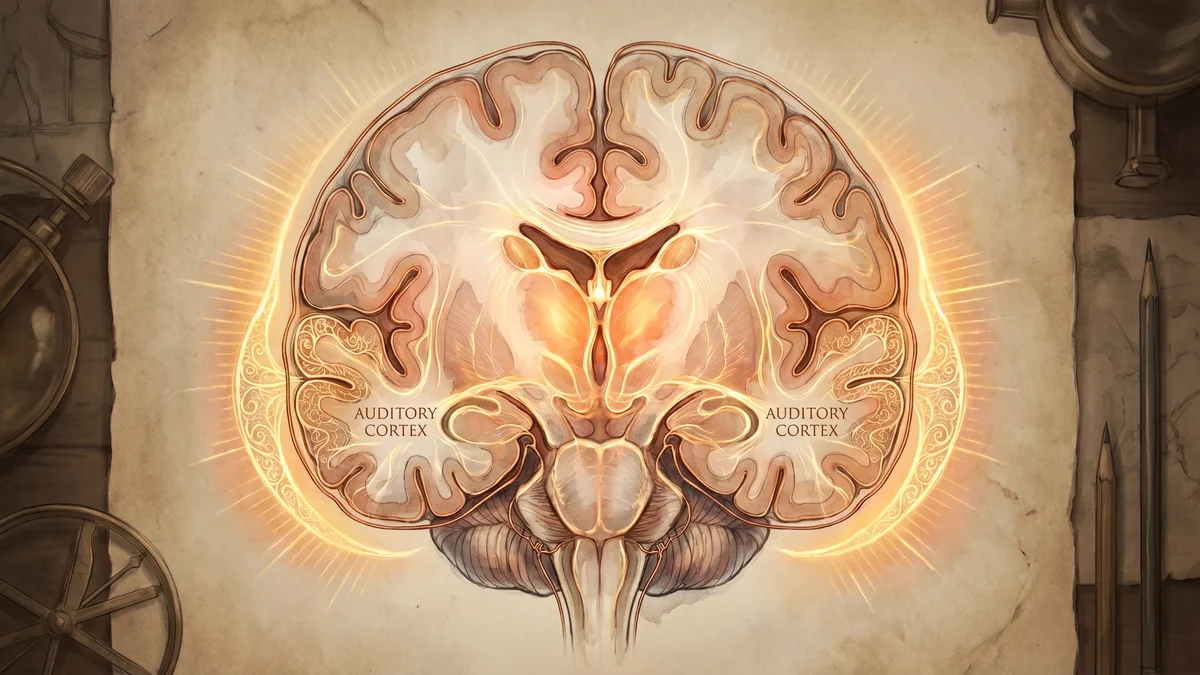
This ancient wisdom is now being validated by modern neuroscience. Researchers like Josef Rauschecker at Georgetown have done important work mapping the neurological underpinnings of tinnitus. His research suggests that tinnitus is not an ear problem, but a brain problem, a kind of phantom perception created by the brain in response to a loss of auditory input. The brain, in its attempt to fill in the missing sensory information, essentially turns up the gain on its own internal noise, creating the perception of a sound that isn't there. Worth sitting with, that one.
This understanding is incredibly supporting. It means that we can, by working with our brains, change our experience of tinnitus. We can, through practices that promote neuroplasticity, teach the brain to turn down the gain, to reinterpret the signal, to uncouple it from the emotional charge of suffering. Attention is the most undervalued resource you have. Everything else follows from where you place it. By consciously and consistently redirecting our attention, by cultivating states of calm and equanimity, we are actively remodeling the neural pathways that create and sustain the distress of tinnitus.
The Companionship of the Breath
In this journey of learning to listen, the breath is our most faithful ally. It is the bridge between the conscious and unconscious, the mind and the body. The breath doesn't need your management. It needs your companionship. When we are caught in a storm of reactivity to the inner sound, the simple act of returning our attention to the gentle, rhythmic flow of the breath can be a lifeline. It is an anchor in the present moment, a safe harbor in the midst of the sensory storm. Each conscious breath is a small act of self-regulation, a message to the nervous system that, in this moment, we are safe.
The practice is not to use the breath to distract ourselves from the sound, but to allow the breath and the sound to coexist in our awareness. We can even begin to explore the relationship between them. Does the sound change as we breathe in? As we breathe out? Can we imagine the breath flowing into and around the sound, softening its edges, creating space? This is the subtle art of inclusion, of making peace with our experience by gently holding all of its parts in a spacious, non-judgmental awareness. The space between knowing something intellectually and knowing it in your body is where all the real work happens.
Another option worth considering is the Jarrow Formulas B-Right Complex (paid link). A popular choice for situations like this is the AfterShokz OpenRun.
The Uncomfortable Invitation
To reframe tinnitus as a call to listen to the inner sound is not to romanticize it or to deny the pain it can cause. It is to accept the reality of it, fully and completely, and then to ask a deeper question: What is this experience asking of me? What is it teaching me? It is an invitation to begin on a journey of significant self-discovery, a journey that can lead to a level of inner peace and resilience that we never thought possible. It is a path that requires immense courage and a willingness to question everything we thought we knew about ourselves and the world.
So, the challenge is this: can you, just for a few moments each day, lay down your weapons and simply listen? Can you suspend your judgment, your fear, and your desperate desire for silence, and just be with the sound as it is? Can you treat it not as an enemy, but as a messenger, a teacher, a guide? The path is not easy, but it is a path that leads not away from the sound, but through it, to the silence that lies beneath.
Your Healing Journey: Tools Worth Exploring
While there is no single solution for tinnitus, many people find that the right combination of tools and practices makes a real difference in daily life. Here are some options that align with what we have discussed in this article.
Something worth considering might be Hearos Musician Earplugs. Check out the NOW Supplements NAC 600mg (paid link) and see if it fits your situation.
A popular choice for situations like this is the AfterShokz OpenRun. Check out the Mini Stepper by Sunny Health (paid link) and see if it fits your situation.
Something worth considering might be the Sony WF-1000XM5 earbuds. Check out the CoQ10 by Doctor's Best (paid link) and see if it fits your situation.
We may earn a small commission from Amazon purchases, which helps support this site at no extra cost to you.
Frequently Asked Questions
Are you saying my tinnitus is a good thing?
Not at all. The suffering caused by tinnitus is real and valid. The perspective offered here is not about labeling the experience as "good" or "bad," but about exploring whether it can be used as a tool for growth. It's a re-contextualization. Instead of seeing it solely as a medical problem to be eliminated, we are exploring it as a phenomenon that can, if approached with awareness, lead to significant self-discovery and a deeper connection to the present moment.
What is the difference between 'inner sound' in meditation and tinnitus?
In many contemplative traditions, the 'inner sound' or 'Nada' is a subtle, high-frequency vibration sought out during deep meditation as a sign of spiritual progress. Tinnitus is a clinical condition, often resulting from hearing damage, that is typically perceived as much louder and more intrusive. The radical proposal here is that they may be two ends of the same spectrum. Tinnitus could be seen as an increased, "pathologized" version of this natural inner resonance, one that we can learn to relate to with the same reverence and curiosity as a meditator relates to the Nada.
How does Jon Kabat-Zinn's work apply here?
Jon Kabat-Zinn's Mindfulness-Based Stress Reduction (MBSR) is a secular, evidence-based program for working with stress, pain, and illness. Its core principle is that while we may not be able to change our physical condition, we can fundamentally change our relationship to it through mindfulness. By systematically cultivating non-judgmental, moment-to-moment awareness of our thoughts, feelings, and bodily sensations (including tinnitus), we can uncouple the raw sensation from the secondary layers of suffering, such as anxiety and catastrophic thinking, which dramatically reduces its negative impact on our lives.